SRS repair guide
Airbag Module Reset: What It Is, When You Need It, and What to Expect
Your car has been repaired after a crash, the new airbags are in, and the SRS warning light still won't go off. Here's why that happens and how to fix it with an Airbag Module Reset, without paying dealer prices for a new control module.
Most people never think about the airbag control module until after an accident. Then a body shop or mechanic tells them the airbag light is on, the module has "crash data" stored, and a new one from the dealer costs anywhere from a few hundred to well over a thousand dollars before programming. That's usually when people start searching for alternatives.
I've put this guide together because the information online tends to be either very technical or very salesy. The goal here is to explain, in plain terms, what the module does, why it locks up after a collision, and what your realistic options are.
What the airbag module actually does
The airbag control module, also called the SRS module, ACU (airbag control unit) or RCM (restraint control module), is the small computer that decides whether to fire your airbags. It's usually bolted to the floor under the center console or under one of the front seats, close to the car's center of mass.
It does a few jobs at once:
- Watches the crash sensors. It reads accelerometers inside the module and impact sensors mounted around the car.
- Decides when to deploy. Within a few milliseconds, it determines whether an impact is severe enough to fire the front airbags, side curtains, knee bags and seat belt pretensioners.
- Runs self-checks. Every time you start the car, it tests the circuit to each airbag and pretensioner. If something is wrong, the SRS light stays on.
- Records the event. If a crash happens, it writes a record to its internal memory, sometimes called hard codes or crash data.
Why the SRS light stays on after a crash
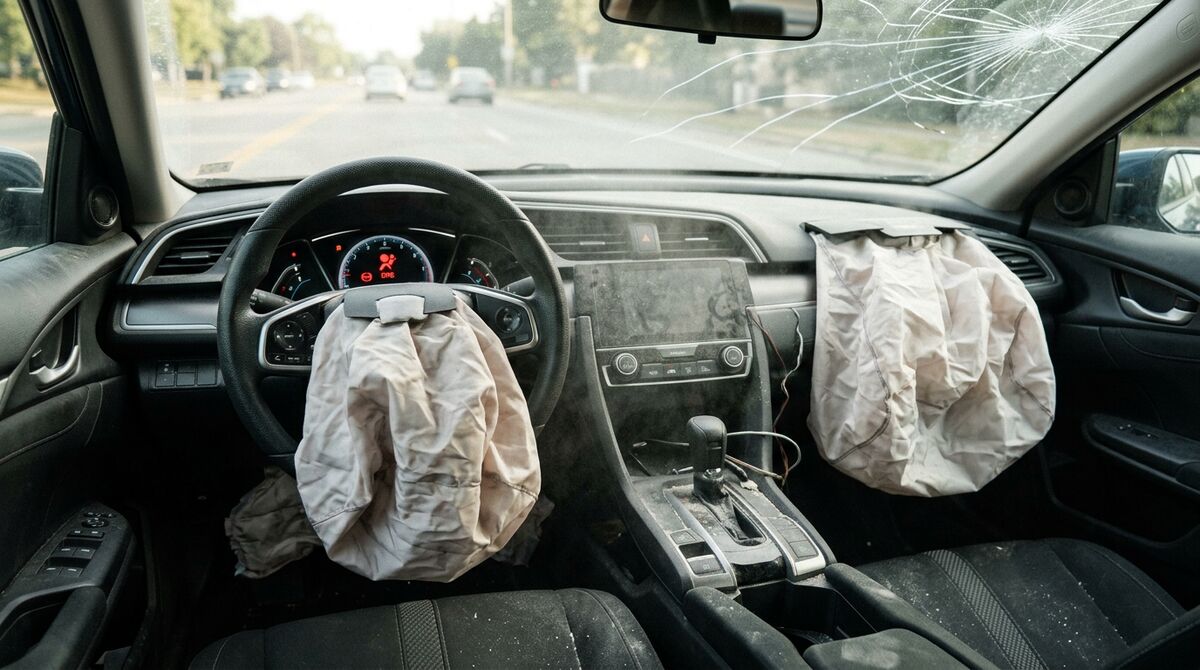
This is where most of the confusion comes from. After a deployment, the module doesn't just log a normal trouble code you can clear with a scan tool. It writes the crash record into protected memory, and manufacturers design it so that record cannot be erased through the OBD-II port.
So even after a shop has replaced every deployed airbag, the clock spring, the seat belt pretensioners and any damaged sensors, the module still "remembers" the crash and refuses to arm the system. The light stays on, and in many vehicles the airbags won't deploy again until the module is dealt with.
A lit SRS light means your airbags may not deploy in the next accident. It isn't just an annoyance, and many states and inspection programs treat it as a safety failure.
Other signs the module has locked
- The airbag light comes on and stays on, sometimes flashing a pattern.
- A scan tool shows codes like "crash data stored," "deployment commanded," or a manufacturer-specific hard code that won't clear.
- The passenger airbag indicator behaves oddly.
- On some cars, the seat belt warning or other body systems act up because they share a network with the SRS module.
The light can also come on for reasons that have nothing to do with a crash, like a failing clock spring, a loose connector under a seat, a weak battery or a faulty occupant sensor. Those are ordinary soft codes and can usually be fixed and cleared normally. A reset only makes sense when the module itself is holding crash or locked data.
What an airbag module reset involves
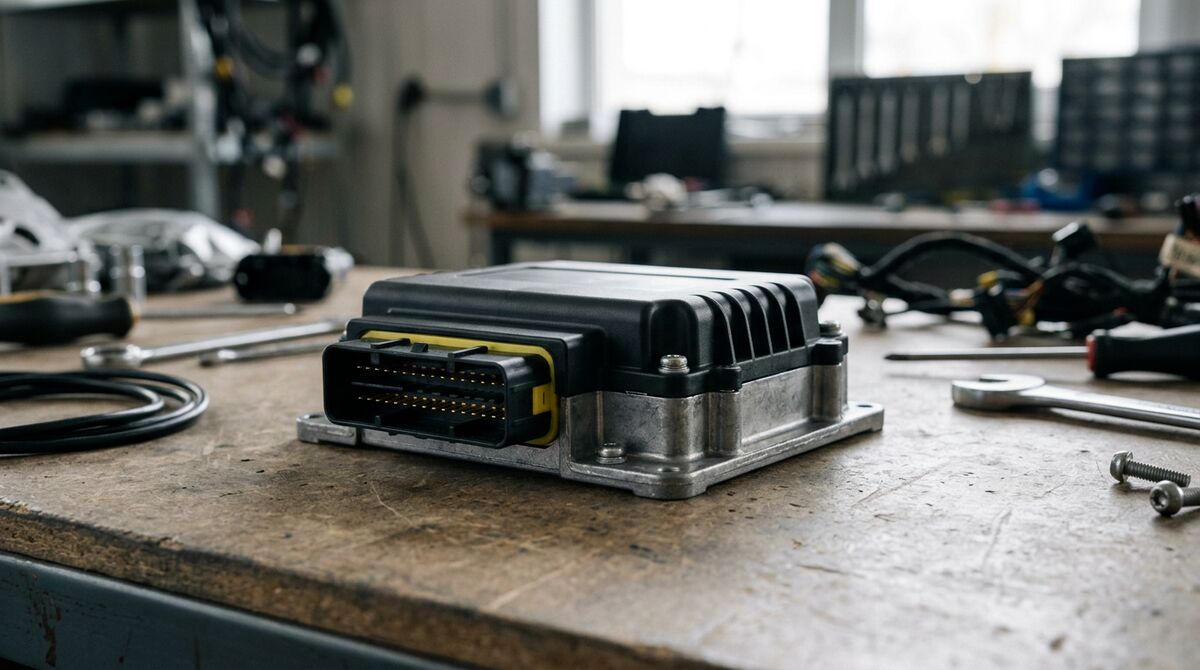
An airbag module reset is a bench procedure. A technician removes the module from your car (or you do), sends it to a specialist, and the specialist reads the memory chip directly, removes the crash record and hard codes, and puts the module back to the state it was in before the accident. Your original VIN, mileage-related settings and factory configuration stay the same.
Done properly, the module comes back as your module, not a used part pulled from another car. That's the main reason it usually goes back in without programming.
The typical process
- Disconnect the battery and wait the time your service manual recommends (often a few minutes) so the system's backup capacitor drains.
- Remove the module. It's usually under the center console or a front seat. Unplug the connector carefully and note the part number on the label.
- Ship or drop it off with the specialist. Most mail-in services include a form for your VIN and vehicle details.
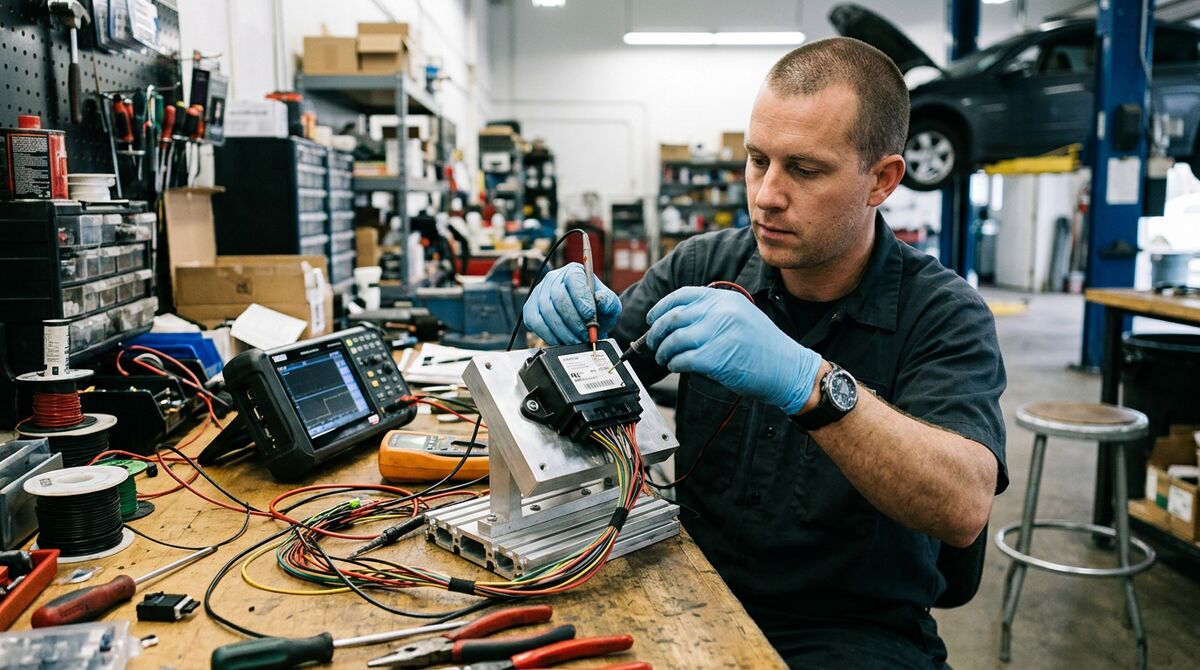
- Bench reset and test. The crash data is cleared and the module is checked before it goes back out.
- Reinstall, reconnect the battery, and confirm the SRS light goes through its normal self-test and turns off.
Before you send anything off, have the rest of the system checked. If a deployed airbag, a pretensioner or a sensor hasn't been replaced, the light will come right back on and the module will log a new fault. The reset fixes the module, not the parts around it.
Reset vs. replace: comparing your options
There are basically three ways to deal with a locked airbag module. Here's how they compare in practice:
| Option | Typical cost | Programming needed? | Things to know |
|---|---|---|---|
| New module from the dealer | Highest, often several hundred to over $1,000 plus labor | Usually yes, at the dealer | Brand-new part, but the most expensive and sometimes back-ordered. |
| Used module from a salvage yard | Low to moderate | Often yes; may be VIN-locked to the donor car | Could hold its own crash data. History unknown. Part numbers must match exactly. |
| Reset your own module | Usually the lowest | Normally no, plug-and-play | Keeps your original configuration. Requires removing and shipping the unit. |
For most owners, resetting the original module is the practical choice. It costs less than a new unit, avoids the uncertainty of a junkyard part, and skips the dealer programming visit. The main exceptions are modules that are physically damaged (water intrusion, cracked housing, burnt circuit board), which need to be replaced rather than reset.
What to look for in a reset service
Not every service is the same, and since this is a safety part, it's worth asking a few questions first:
- Do they support your exact module? Coverage varies by make, model, year and part number. A good service will confirm before you ship.
- Do they clear all stored data, including crash records and hard codes, not just the visible codes?
- Do they test the module before returning it?
- What's the turnaround? Same-day processing after arrival is common with established services.
- Is there a warranty and a clear policy if the module turns out to be unrepairable?
- Is the price straightforward, with return shipping explained up front?
One service that ticks these boxes and comes up often in repair forums and body-shop recommendations is Toki Auto. They handle mail-in airbag module resets for a wide range of makes and lay out the process clearly on their site, which is helpful if you're doing this for the first time.
Common mistakes to avoid
- Working on the system with the battery connected. Airbags are pyrotechnic devices. Always disconnect power first and follow the manual.
- Using a resistor to fool the light. Some people wire a resistor in place of an airbag to turn the light off. This disables a safety system and is illegal to sell a car with in many places.
- Buying a module by look rather than part number. Two modules that look the same can be configured completely differently.
- Skipping the root cause. If the light came on without a crash, diagnose the soft codes before assuming the module is the problem.
- Dropping or shocking the module. It contains accelerometers. Handle and pack it carefully.
Frequently asked questions
Can I just clear the SRS light with a scan tool?
Only if the stored codes are ordinary, non-crash faults. Once a module has logged a deployment, the crash data is hard-locked and a scan tool can't erase it. The module has to be reset at the memory level or replaced.
Is a reset module as safe as a new one?
A properly reset module runs the same original factory firmware and hardware. The reset only removes the stored crash record and fault codes. Overall safety depends on the rest of the system being repaired correctly too.
Will I have to program the module after it comes back?
Usually not. Because your own module comes back with its original VIN and configuration, it's normally plug-and-play. A used or new replacement often needs programming.
Does a minor accident without airbag deployment lock the module?
It can. Many modules record a "non-deployment event" when they detect an impact that wasn't severe enough to fire the airbags. Depending on the manufacturer, that alone can keep the SRS light on.
How long does a reset take?
The bench work is quick. Most of the time is shipping. Many mail-in services process the module the day it arrives, so the total is often a few business days.
Can every module be reset?
Most can, but not all. Modules with physical damage, corrosion from flooding, or some very new encrypted designs may need replacement. A reputable service will tell you before taking your money.
The bottom line
If your airbags have deployed, or your car was in a collision and the SRS light won't go out after repairs, the module is very likely holding crash data. Replacing it at the dealer is the expensive route. In most cases, resetting your original module gets the system back to factory condition for a fraction of the cost, without programming headaches.
Get the surrounding parts repaired first, confirm your module part number, and choose a service that tests what it sends back. If you'd like to see how the process works with a mail-in service, Toki Auto's site walks through it step by step.